Interiors should not be the product of ephemeral style trends, but of a client’s own personality and preference. Studio Clementine takes a collaborative approach, both between client and studio, and in terms of the many specialist skills and suppliers our designers bring to a project. We pride ourselves on listening to what people want and then surpassing expectations both creatively and in delivering a seamless, personal service.

DESIGNING FOR CREATIVES
HOW TO CREATE A FASHION DESIGNER'S DREAM HOME
Designing a home for a fashion designer presents a unique and exhilarating opportunity: working with a client who understands colour, texture, silhouette, and storytelling at an instinctive level. When fashion designer Harris Reed met Studio Clementine to transform his compact West London apartment, the brief was wonderfully clear: create a space as bold, personal, and unapologetically creative as his runway collections.
This project exemplifies how interior design for creative clients requires translating aesthetic vision into liveable spaces while honouring their unique creative language. As an interior designer in London working with creative professionals, I've found that these collaborations yield some of the most rewarding and distinctive results.

THE INTERSECTION OF FASHION AND INTERIOR DESIGN
The relationship between fashion and interior design runs deeper than surface aesthetics. Both disciplines fundamentally concern themselves with how people inhabit space, whether that space is a room or the personal territory created by clothing. Both use visual language to communicate identity, mood, and feeling.
SHARED DESIGN LANGUAGE: COLOUR, TEXTURE AND FORM
Colour theory applies identically to fashion and interiors. The way complementary colours create feeling, how complementary palettes produce harmony, and the emotional resonance of warm versus cool tones, these principles transcend discipline. Harris's fashion collections often feature jewel-toned velvets, metallic embellishments, and unexpected colour combinations. These same sensibilities informed our interior palette: rich colours and deep hues, brass accents catching light, surprising moments of pink softening bolder gestures.
Texture operates similarly across both fields. Just as Harris layers different fabrications in a single garment, matte wool against shimmering silk, rough tweeds with delicate lace. We approached his interiors with the same textural complexity. This layering is something we Interior Designers are used to and play with daily, without the limitations of what texture feels and moves like on the skin, but rather how they read to the eye within a space.
Form and silhouette matter equally in both disciplines. The curved back of a vintage chair echoes the structure of a well-cut jacket. The drape of curtains relates directly to how fabric falls in a gown. Fashion designers instinctively understand these relationships, which makes discussing spatial composition remarkably intuitive.
FROM FABRIC TO FURNISHINGS: MATERIAL CONNECTIONS
One of the most natural crossovers between fashion and interior design lies in materials and textiles. Fashion designers already possess sophisticated knowledge about fabric properties, quality, and application. They understand thread counts, weave structures, and how different materials perform over time.
This knowledge proved invaluable when specifying textiles for Harris's apartment. We could discuss the hand of a velvet, the weight of a silk, the durability of various weaves in the same vocabulary he uses daily. When selecting upholstery for his living room sofa, Harris immediately understood why we recommended a particular mohair velvet, its resilience, its light-catching properties, its tactile appeal.
PERSONAL STYLE ACROSS DISCIPLINES
I always observe how clients dress. Someone's wardrobe offers immediate insight into their aesthetic preferences, their comfort with colour, their attention to detail, and their willingness to take risks. A client who wears predominantly neutral, minimalist clothing likely wants interiors that reflect that restraint. Someone who layers patterns and embraces bold accessories probably craves similar complexity in their spaces.
Harris's personal style, theatrical, gender-fluid, and unafraid of attention, translated directly into his interior preferences. His wardrobe's maximalist approach, mixing historical references with contemporary irreverence, informed every design decision in his apartment. The confidence he brings to fashion carries through to interior choices that many clients would find intimidating.
This alignment between personal presentation and domestic environment isn't coincidental. Both fashion and interior design are expressions of identity, ways of communicating who we are and how we want to be perceived. Fashion designers understand this relationship intuitively, which makes the design process remarkably coherent.
USING AESTHETIC REFERENCES: THE WES ANDERSON BATHROOM
One of the most effective tools when working with creative clients is the shared aesthetic reference. Rather than describing desired outcomes in abstract terms, "elegant but not stuffy," "colourful but sophisticated", specific cultural references create immediate mutual understanding.

WHY AESTHETIC REFERENCES WORK FOR CREATIVE CLIENTS
When Harris mentioned Wes Anderson as inspiration for his bathroom, we both instantly understood the aesthetic territory: symmetrical composition, pastel colour palettes, quirky vintage details, a sense of theatrical staging where every element feels deliberately placed. These references function as visual shorthand, eliminating the ambiguity that often plagues design conversations.
Harris's bathroom became the perfect space to embrace this aesthetic fully. Powder rooms and bathrooms offer unique freedom for bold design choices because their compact size and specific function allow for theatrical gestures that might overwhelm larger, more frequently used spaces.
The Wes Anderson aesthetic breaks down into several key elements: rigorous symmetry, pastel colour palettes (particularly pinks, greens, and yellows), vintage fixtures with character, and an almost stage-set quality where everything feels deliberately composed. We translated each of these principles into the bathroom design.
The attention to detail extended to every fixture and finish. Period-appropriate taps in brass, a vintage-inspired medicine cabinet, and even the towel rail, each element reinforced the overall aesthetic. This consistency prevents spaces from feeling cobbled together, instead creating the cohesive vision that makes Anderson's films so visually distinctive.
FROM INSPIRATION TO IMPLEMENTATION
The success of aesthetic references depends on understanding their core principles rather than superficial replication. We weren't sourcing props from Wes Anderson films; we were identifying what makes his visual language distinctive and applying those principles to create something original.
This approach works particularly well with fashion designers because they're accustomed to this kind of conceptual translation. Fashion collections constantly reference art, film, history, and culture without becoming costume. The skill lies in extracting essence rather than copying form, precisely what effective interior design requires.
The bathroom proved that bold, personality-driven design could exist within a small, functional space. It became one of Harris's favourite rooms, demonstrating that limitations, whether it be budget, space, or function, need not constrain creativity when the vision remains clear, and the execution stays committed.
WEAVING PERSONAL NARRATIVES: THE POWER OF MOTIFS IN INTERIOR DESIGN
Beyond aesthetic references and design principles, truly exceptional interiors incorporate personal meaning. Generic luxury (however well-executed) lacks the emotional resonance that transforms a house into a home. This is where bespoke elements and personal motifs become essential, creating spaces with genuine soul.
BEYOND DECORATION: PERSONAL MEANING IN DESIGN
Interior design at its best tells the occupant's story. Not just through literal representation, such as framed photographs and displayed collections, but through woven-in details that carry private significance. These personal touches separate professionally designed spaces from showroom displays, adding layers of meaning that deepen over time.
Fashion designers understand narrative design instinctively. A collection isn't just beautiful clothes; it's a story told through visual language. Harris's collections often explore themes of identity, transformation, and self-expression. His home needed to reflect these same values, creating spaces that celebrated authenticity and personal truth.
THE BEE MOTIF: A LOVE STORY IN WALLPAPER
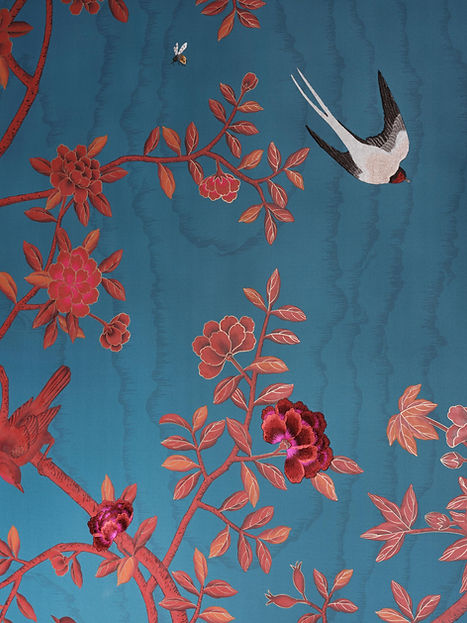
One of the most beautiful personal elements in Harris's apartment emerged from a simple revelation during our conversations: Harris calls his husband Eitan his "little bee", a private endearment that captures something essential about their relationship. This small detail became the foundation for one of the project's most significant bespoke elements. We commissioned Fromental, whose exquisite hand-painted wallcoverings I have long used, to create custom wallpaper incorporating bee motifs throughout the design. The wallpaper appears in the bedroom, and every time Harris and Eitan are in that space, they're surrounded by this visual representation of their relationship.
This is what bespoke design offers that off-the-shelf luxury cannot: meaning that transcends aesthetics, creating emotional resonance impossible to achieve through catalogue selections alone. The Fromental wallpaper isn't just beautiful (though it absolutely is), it's meaningful in ways that make the space irreplaceable and deeply personal.
CREATING BESPOKE ELEMENTS FOR PERSONAL NARRATIVES
The bee motif exemplifies our approach to personalisation: finding symbols or elements with genuine significance and incorporating them with sophistication and restraint. Personalisation fails when it becomes literal or obvious. The goal isn't to broadcast private meaning to visitors but to create layers of significance for the occupants themselves.
Other personal touches throughout Harris's apartment include vintage pieces with provenance, artworks by friends and collaborators, and textiles with personal significance. Each element contributes to the overall narrative without requiring explanation. The space feels uniquely his, not because it announces "this belongs to Harris Reed" but because every decision reflects his actual tastes, values, and relationships.
This approach works particularly well with creative clients who inherently understand that the most powerful storytelling often operates subtly. They don't need every detail explained or justified; they trust that the accumulated effect creates resonance.
Working with artisans like Fromental, Locker & Riley for bespoke plasterwork, and Seamers for custom joinery allowed us to create one-of-a-kind elements impossible to replicate. These collaborations with master craftspeople add another layer of meaning: the knowledge that skilled hands created something specifically for this space, for this client, with care and intention.
The emotional impact of these personalised elements extends beyond the aesthetic. They create a sense of rootedness, of belonging, that generic interiors can never achieve. Harris's apartment doesn't just look beautiful; it feels like home because it tells his story.
BOLD COLOUR CHOICES: DESIGNING EXPERTIMENTAL PALETTES FOR FASHION DESIGNERS
Colour might be the single most defining characteristic of work with fashion designers. While many residential clients approach colour tentatively, fashion designers understand colour's power intimately. They've spent careers studying colour theory, observing how hues interact, recognizing colour's ability to transform mood and perception.
FASHION DESIGNERS AND FEARLESS COLOUR
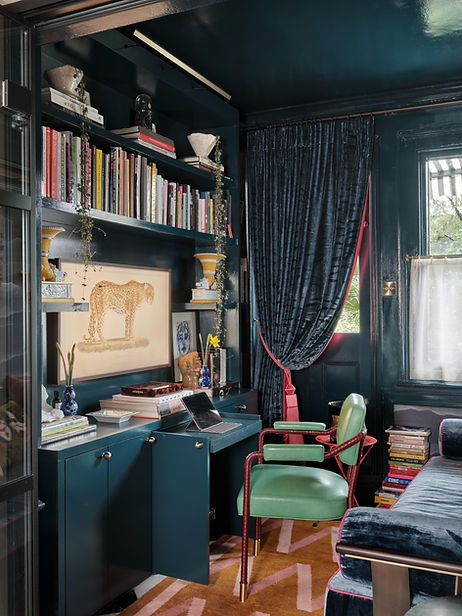
Harris Reed's fashion collections celebrate colour unapologetically. Rich jewel tones, unexpected combinations, saturated hues that demand attention with runway shows that demonstrate complete colour confidence. This same fearlessness needed to translate into his interiors, creating spaces as bold and saturated as his collections. The key lies in building sophisticated palettes that maintain cohesion despite complexity. Harris's apartment features deep blue walls, forest green accents, blush pink moments, golden brass throughout, a palette that could easily become chaotic. The success depends on understanding colour relationships, balancing saturation with relief, and maintaining tonal consistency even across varied hues.
MAKING BOLD COLOUR LIVEABLE
The concern with bold colour often centres on livability: will intense hues feel oppressive over time? Will they limit flexibility? Will they date quickly? These concerns often prove unfounded when colour is handled with sophistication.
Bold colour actually enhances small spaces rather than shrinking them. The 750-square-foot apartment could have felt cramped with so much saturated colour, but the opposite occurred. The deep, enveloping tones create intimacy and drama, making the space feel deliberate and designed rather than limited. The key lies in committing fully, tentative colour in small spaces amplifies the size issue rather than solving it.
LET THERE BE LIGHT
Lighting becomes crucial with bold colour palettes. We layered lighting carefully (ambient, task, and accent) to ensure the colours read beautifully at different times of day. Evening lighting in particular needed consideration; bold colours can deaden under harsh illumination but glow gorgeously with warm diffused light. The result demonstrates that bold colour, far from being impractical or exhausting, creates spaces with genuine character and atmosphere. Harris's apartment feels vibrant without being overwhelming, dramatic without being theatrical in the wrong way. The colours enhance daily life rather than fighting against it, proving that fearless colour choices can create the most liveable spaces of all.

MAXIMISING IMPACT IN COMPACT SPACES: PRACTICAL SOLUTIONS FOR SMALL APARTMENTS
Harris Reed's apartment presented a significant challenge: how to create the drama, luxury, and functionality he wanted within just 750 square feet. Small space interior design in London requires particular ingenuity, as always the nature of having to work with challenges brings creative solutions.
THE SMALL SPACE CALLENGE: 750 SQUARE FOOT OF BOLD DESIGN
Conventional wisdom suggests restraint in small spaces: light colours to enhance perceived size, minimal furniture to avoid crowding, simple styling to prevent visual clutter. Harris's home violates every one of these "rules." He wanted bold colour, maximal styling, rich layering, everything supposedly forbidden in compact apartments. This apparent contradiction actually presents an opportunity as small spaces benefit from commitment. Half-measures "I'd love dark walls but the space is too small" result in interiors that feel tentative and compromised. Bold choices, fully realised, create spaces with conviction and character regardless of size.
The apartment's compact footprint meant every decision carried extra weight. Poor space planning would create immediate problems. Inadequate storage would lead to visible clutter undermining the aesthetic. Furniture that didn't scale appropriately would overwhelm. Getting small spaces right requires precision and consideration impossible to achieve through compromise.
CREATING GRANDEUR IN COMPACT APARTMENTS
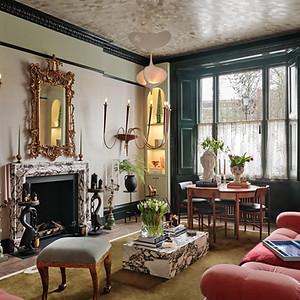
Making small spaces feel grand requires understanding what actually creates the perception of luxury and space. It's less about square footage than about proportion, quality, and considered detail. Ceiling height became an asset, Tall ceilings in any building create vertical volume that counters the limited floor area. We drew attention upward through the Locker & Riley custom ceiling rose in the drawing room, a spectacular piece of bespoke plasterwork that becomes an architectural focal point. Rather than apologising for the apartment's size, we celebrated its period features, creating grandeur through architectural detail.
Quality over quantity governed furniture selection. Better to have fewer pieces of exceptional quality than to fill space with mediocre furnishings. Each piece in Harris's apartment (whether vintage finds or contemporary designs) earns its place through beauty, comfort, and appropriateness to the space.
Mirrors strategically placed reflect light and create spatial complexity, a classical technique that remains effective. The vintage Venetian mirror in the bathroom, ornate and oversized, transforms a small powder room into something special. Similar mirrors throughout the apartment catch light from windows, bouncing it deeper into the space and creating visual interest.
SERVICES WE OFFER
Studio Clementine provides comprehensive interior design services for residential clients throughout London and beyond. Our work ranges from complete home renovations to commercial projects, always maintaining our commitment to quality, craft, and personal character.
Our services include:
-
Full interior design from concept through completion
-
Space planning and layout optimization
-
Bespoke joinery design and specification
-
Furniture, fixture, and equipment (FF&E) sourcing and procurement
-
Colour consultation and scheme development
-
Collaboration with architects and contractors
-
Art and accessories curation
-
Project management and site supervision
We work primarily on high-end residential projects but also collaborate on hospitality and commercial spaces when the brief aligns with our aesthetic and approach. Each project receives Georgina's direct involvement regardless of scale, ensuring consistency of vision and quality throughout.
If you're considering an interior design project whether in London or elsewhere, we'd love to discuss how we might work together to create spaces that genuinely reflect your vision and enhance your daily life.
FURTHER READING
Discover more about how this project came to life through the Studio Clementine Journal.
.png)
View The Full Project
Furniture, Lighting & Accessories